Perimenopause can feel like your body is changing the rules mid-game.
Sleep gets weird. Recovery feels slower. Your mood and energy can be unpredictable. And the workouts that used to “work” sometimes stop feeling as effective (or they suddenly feel like they cost more than they give).
So here’s the reframe I want you to take with you:
You don’t need to move less because your body is changing. You need to move differently with more intention.
Why movement matters more (not less) in perimenopause
Perimenopause is a transition, not a breakdown.
But it is a phase where many women notice shifts in:
- body composition
- strength and muscle tone
- stress tolerance
- sleep quality
- joint comfort and recovery
And when those shifts show up, it’s common to default to the old formula: more cardio, more sweat, more “burn.”
The issue is that perimenopause is often the exact time when your body benefits from movement that supports:
- muscle (strength, function, metabolic health)
- bone (loading and impact when appropriate)
- nervous system regulation (so you’re not living in fight-or-flight)
Research-based resources and experts consistently emphasize that resistance training is especially valuable during the menopause transition. Not because you need to train like an athlete, but because strength is protective.
The missing piece: power
Most women are told to focus on “toning” or “burning calories.”
But one of the most important physical qualities for long-term independence is:
Power.
Power is strength expressed quickly. It’s what helps you:
- catch yourself if you trip
- step quickly on uneven ground
- get up off the floor without a full negotiation
- feel steady when life moves fast
Power tends to decline with age, and that matters because real life isn’t slow and controlled.
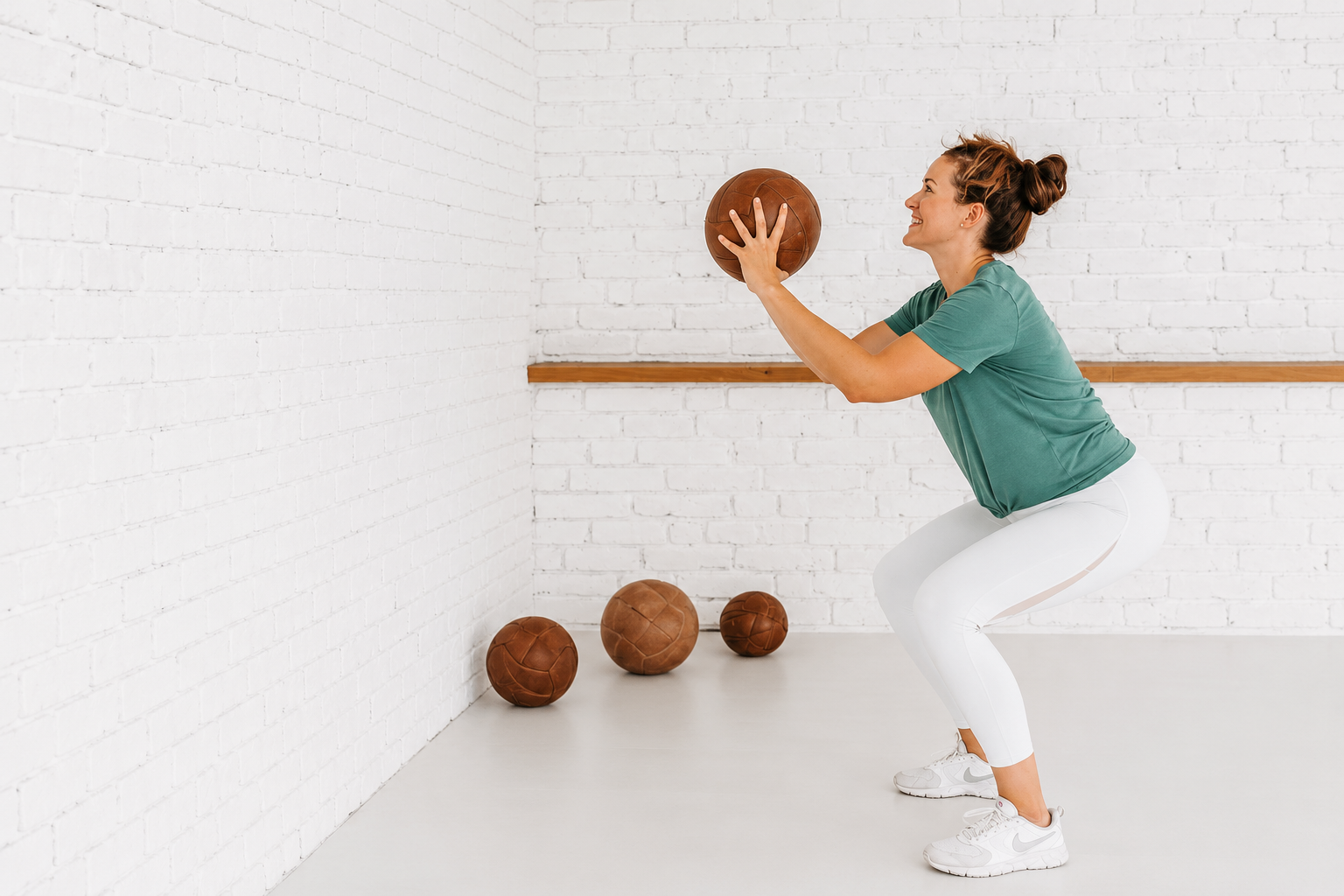
This is why I love using a photo like an overhead medicine ball throw as a visual: it’s a reminder that we’re not training just for smaller bodies, we’re training for capable bodies.
“Moving differently” isn’t one magic workout
This is where perimenopause gets misunderstood.
Women often think the only options are:
- gentle movement (walks, yoga, stretching)
- intense movement (HIIT, bootcamps, grind-it-out cardio)
But the sweet spot is usually a smart mix the right dose of each, based on your stress, sleep, cycle changes, and recovery.
Here’s a simple movement “menu” that tends to be supportive for many women in this phase:
- Strength training (progressive resistance)
- Power work (short bursts, high quality, plenty of rest)
- Steady cardio (for heart health and endurance)
- Mobility / yoga (for range of motion, body awareness, recovery)
- Rest (because adaptation happens there)
You’re not failing if you need more recovery than you used to. That’s not weakness, that’s information.
Can movement help symptoms?
Movement isn’t a magic wand, and I’m not going to promise it will “fix” perimenopause.
But exercise, especially strength-focused training, has been studied for its role in supporting health outcomes that often shift during the menopause transition. Some research also suggests exercise can help reduce certain menopause-related symptoms.
The key is the approach:
- not always more volume
- not always more intensity
- more progressive strength
- more quality
- more consistency
Because if your workouts leave you wired, exhausted, and craving sugar in a way that feels chaotic, your body doesn’t experience that as “health.” It experiences it as stress.
The nervous system piece (the one nobody warns you about)
Perimenopause can be a season where stress hits differently.
So yes, we want strength and power.
But we also want to train in a way that communicates safety:
- shorter, focused sessions
- clear structure
- enough rest between hard efforts
- leaving a little in the tank
This isn’t about being soft.
It’s about being strategic.
The takeaway
If you’re in perimenopause and you feel like you “should” only do gentle movement, here’s your permission slip:
You can be gentle and train strength. You can be regulated and train power. You can honour your body and challenge it.
The goal isn’t to fight your body.
It’s to move in a way that supports the body you’re living in now, so you feel capable, steady, and strong for the long run.
Educational only, not medical advice. If you have pain, pelvic floor symptoms, or medical conditions, work with a qualified professional to tailor exercise to you.